.png "Издательство «Логос Пресс»")
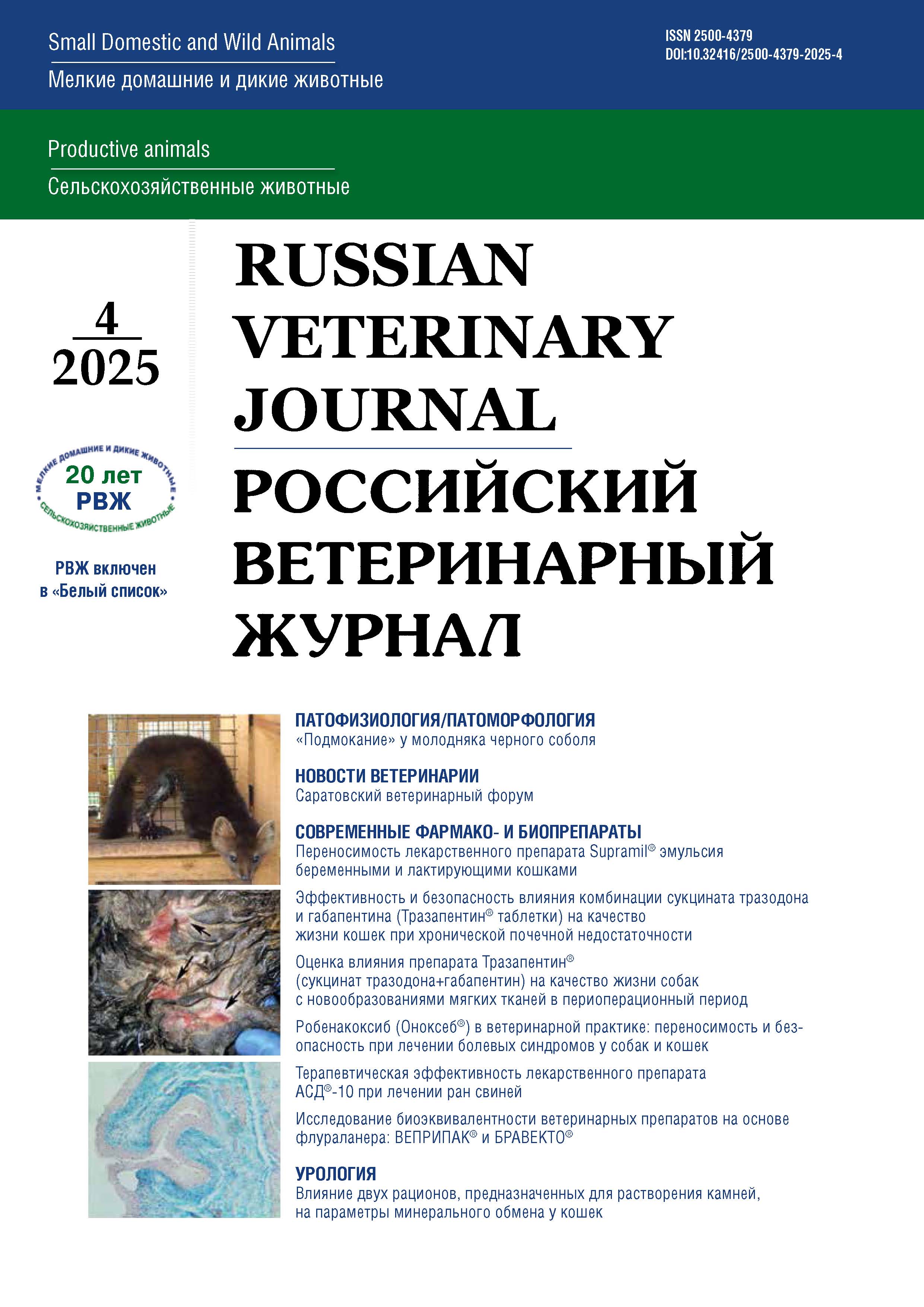
«Подмокание» у молодняка соболей клеточного содержания является экономически значимой проблемой современного звероводства в России. Заболеваемость молодняка соболей может достигать 6 %. Технологический цикл клеточного выращивания соболей не предусматривает вакцинаций и других диагностических манипуляций в связи с активной реакцией животных на внешние раздражители и высоким риском стресса для них. В этой связи при диагнозе «подмокания» у молодняка соболей регламент ветеринарного вмешательства предусматривает только местную аэрозольную обработку антимикробными препаратами. Исследования, посвященные этиологии и патогенезу «подмокания» у молодняка соболей, немногочисленны. Остаются неизвестными причины и патофизиологические механизмы развития «подмокания», в частности, механизмы нарушения мочевыделения и недержания мочи. В нашей работе проведен анализ мочи и данных патологоанатомического вскрытия у 76 молодых соболей с диагнозом «подмокание». В результате у животных выявлена сопутствующая патология органов пищеварительной и респираторной системы, а также гистологические признаки цистита и вероятной инфекции мочевыделительных путей Escherichia coli. Однако у 26 % самцов и 33 % самок патология внутренних органов и органов мочевыделительной системы не выявлена. Подобные находки требуют дальнейшего поиска причин и механизмов развития заболевания.
Ключевые слова: соболь, анализ мочи, патология, «подмокание», недержание мочи, аутопсия, гистология.
«Wet belly» in young sables
V.E. Sobolev, Grand PhD in Biol. Sc., Leading researcher at the IEFB RAS.
Sechenov Institute of Evolutionary Physiology and Biochemistry, Russian Academy of Sciences, 194223, Thorez 44, Saint Petersburg, Russia.
«Wet belly» in young sables kept in cages is an economically significant problem in modern fur farming in Russia. The incidence of disease in young sables can reach 6 %. The technological cycle of cage breeding of sables does not provide for vaccinations and other diagnostic procedures due to the animals’ active reaction to external stimuli and the high risk of stress for the animals. In this regard, when diagnosing «wet belly» in young sable, the veterinary intervention protocol provides only for local aerosol treatment with antimicrobial drugs. There are few studies on the etiology and pathogenesis of «wet belly» in young sable. The causes and pathophysiological mechanisms of the development of «wet belly», in particular, the mechanisms of urinary dysfunction and urinary incontinence, remain unknown. In our work, we analyzed urine and pathological autopsy data from 76 young sables diagnosed with «wet belly». As a result, the animals were found to have concomitant pathology of the digestive and respiratory systems, as well as histological signs of cystitis and probable Escherichia coli infection of the urinary tract. However, in 26 % of males and 33 % of females, no pathology of the internal organs or urinary system was detected. Such findings require further investigation into the causes and mechanisms of the disease.
Key words: sable, urinalysis, pathology, «wet belly», urinary incontinence, autopsy, histology.